
A plain-language guide to blending PC INR and PCFC smartly — and how USD/INR movement affects your actual loan repayment
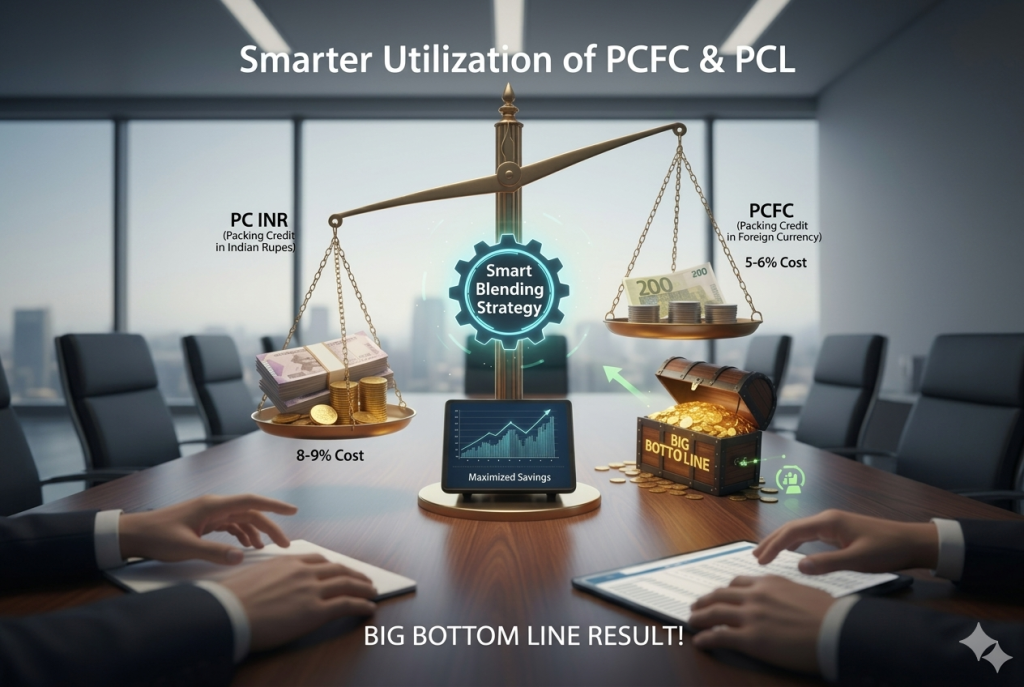
What most SME exporters don’t realise is that the cost of this working capital quietly eats into profit every single month.
There is a simple way to reduce this cost — without changing your business model or taking extra risk.
Saving 2 to 3% can shift your yearly profit.”
It involves using two tools that almost every bank already offers. Used in the right mix, they can reduce your interest cost by 150 to 300 basis points — a serious saving for SME exporters working on 4 to 7 percent net margins.
Your Two Basic Tools — Explained Simply
You don’t need to be a finance expert to understand this. There are just two products to know.
| Feature | PC INR | PCFC |
|---|---|---|
| Full Name | Packing Credit in Indian Rupees | Packing Credit in Foreign Currency |
| Borrowing Currency | Indian Rupee (₹) | USD / EUR / GBP |
| Typical Interest Rate | 8 to 9% per year | 4.5 to 6% per year |
| How Rate is Set | Bank’s lending rate | SOFR / EURIBOR + spread (0.75–1.25%) |
| Repayment | In rupees, after conversion | Directly from foreign currency proceeds |
| Currency Risk | None — stable and predictable | Moves with USD/INR rate |
| Best Used When | Rupee is volatile or weakening | Rupee is stable or strengthening |
| Potential Saving | — | 2 to 3% lower than PC INR |
PCFC is significantly cheaper — but it behaves differently when USD/INR moves. The smart approach is not to choose one over the other permanently. It is to blend both based on the currency situation.
How USD/INR Movement Really Affects Your PCFC Loan
Real Example
This is the part most SMEs don’t fully understand — and it is the most important thing to know about PCFC.
Starting position:
PCFC Loan → USD 1,00,000
USD/INR rate at start → ₹88
Bank shows your outstanding as → ₹88 lakh
Now see exactly what happens when the rupee moves in either direction:
This is why many SMEs prefer PC INR pre-shipment when the rupee is weakening — and shift to PCFC when the rupee is stable or strengthening.
The Double Benefit — PCFC + Hedging Together
Here is the part most exporters don’t think about — and it is genuinely powerful.
When the rupee is stable or appreciating, using PCFC together with a forward contract gives you two benefits at the same time:
When rupee is stable or strengthening → PCFC + forward contract is your most profitable combination.
When rupee is volatile or weakening → shift more weight to PC INR for predictability.
The Smart Blend — What Mix to Use and When
The smartest exporters don’t depend on one product alone. They blend PC INR and PCFC based on the rupee trend and their shipment cycle. Here is how it works in practice:
| Market Condition | Recommended Blend | Visual Mix | Why |
|---|---|---|---|
| Rupee volatile / depreciating | 70% PC INR + 30% PCFC | Protect against rising INR repayment | |
| Rupee stable / moderate | 50% PC INR + 50% PCFC | Balance cost saving with risk control | |
| Rupee strong / predictable | 30% PC INR + 70% PCFC | Maximum interest cost saving |
Post-shipment is simpler. Once your invoice is raised and your receivable is in USD/EUR — use PCFC by default. Your loan and repayment are in the same currency. Your export proceeds repay the loan naturally. Interest cost is 2 to 3% lower. No extra currency risk.
A Simple 3-Step Plan — Start Using This Today
You don’t need a treasury team to implement this. Here is a clean playbook any SME exporter can follow immediately.
Maintain a 6-month export cash flow plan
Use a simple Excel file. Note your expected payment dates, shipment dates, and realisation dates for the next six months. This one habit helps you decide how much PC INR or PCFC you need — and exactly when. Without this visibility, you are always reacting instead of planning.
Blend PC INR and PCFC based on the rupee trend
Use the blending table above as your guide. You don’t need to predict where USD/INR will go — you only need to observe the current trend and adjust your mix accordingly. This single change alone can bring your effective borrowing cost down to the 6 to 7% range.
Negotiate the spread on your PCFC
Banks often quote higher spreads on PCFC — sometimes 1.5% or more when the standard is 0.75 to 1.25%. Ask your relationship manager for a better rate. Show them your track record and your export volumes. A small negotiation can save your business lakhs every year. Most SMEs never ask — that is exactly why this saving is still sitting on the table.
Quick Reference — When to Use What
| Situation | Recommended Choice | Reason |
|---|---|---|
| Rupee is weakening sharply | Prefer PC INR | PCFC repayment burden rises — avoid |
| Rupee is stable | 50/50 blend | Balance cost and predictability |
| Rupee is strengthening | Prefer PCFC | Lower cost + cheaper repayment |
| Post-shipment (invoice raised) | Always use PCFC | Same currency — no extra risk, lower cost |
| PCFC + forward booked at good rate | Best combination | Protected export rate + lower repayment |
| Bank quoting high spread on PCFC | Negotiate first | Standard spread is 0.75–1.25% — push back |
Interest cost management is not complicated
It simply needs a clear understanding of when to use PC INR, when to use PCFC, how USD/INR movement affects your actual repayment — and how to blend both instead of depending on a single product.
For Indian SME exporters, this blended approach can lower interest costs, protect margins, and make your working capital cycle significantly smoother — without any change to your business model.
The saving is already there. It just needs a simple, consistent process to capture it.