
A practical behavioural finance guide for exporters to protect forex margins — without predicting USD/INR
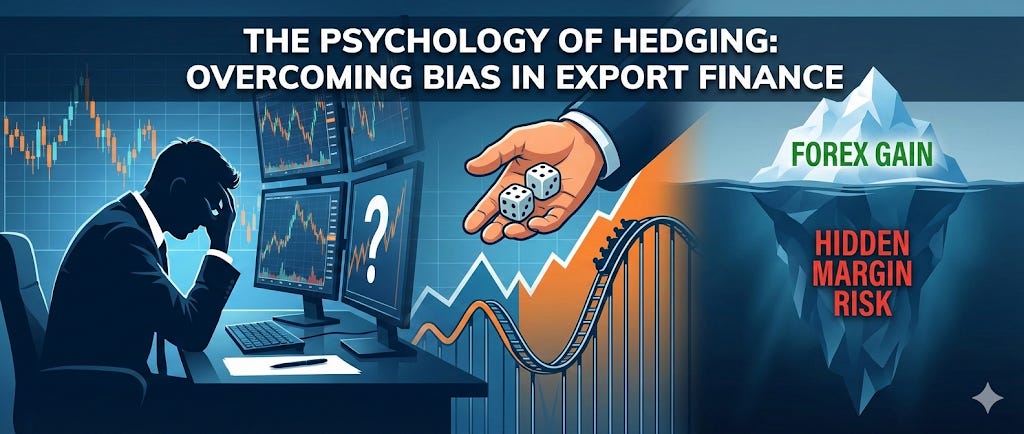
“Should I hedge now… or should I wait?”
If you hedge now and the rate goes higher tomorrow, you feel like you booked the wrong rate. If you don’t hedge and the rate falls, one bad week can eat the profit of the whole shipment.
Both choices feel risky. And the market gives only one thing for free: regret after the move.
It’s how the mind handles uncertainty.”
In behavioural finance, this is a normal human pattern: when outcomes are uncertain, the brain doesn’t search for the best decision — it searches for the least emotionally painful decision.
That’s why exporters who are extremely rational in operations can become surprisingly emotional in FX. Below are the main behavioural biases that quietly distort hedging decisions — and how to fix them with a simple, professional process.
Omission Bias — “Doing nothing feels safe”
The Bias
We judge a wrong action more harshly than a wrong inaction. Many exporters say: “I’m not trading. I’m just keeping receivables open.” But “no hedge” is not neutral. It is an active position — you are fully exposed to USD/INR movement. It delays action until fear forces it — usually too late.
“We are not ‘not hedging’. We are currently at 100% open exposure.”
That single reframe removes false comfort and creates clarity.
Loss Aversion & Regret Aversion — avoiding small regret invites big damage
The Bias
Losses hurt more than gains feel good. So we try to avoid decisions that could cause regret later.
Hedge, and rate goes higher → immediate regret (“I locked the worst rate”).
Don’t hedge, and rate falls → delayed pain (margin damage).
The mind avoids a small visible regret, but accepts a large invisible risk.
Hedging is not about picking the best rate. It is about protecting the margin floor.
Anchoring — the first hedge rate becomes a “mental price tag”
The Bias
Once we see a number, the mind treats it as a reference point — even when it should not. Even if you hedge only 25%, and then USD/INR rises, many exporters freeze. They hesitate to hedge more at higher rates because it feels like admitting the first hedge was “wrong”.
When rates improve (good for exporters) — hedging slows.
When stress rises — hedging increases.
Execution becomes backward.
If your product selling price improves, do you stop selling? No.
Hedging more at higher USD/INR is not failure — it is selling future dollars at a better rupee price.
Mental Accounting — “P&L says gain” while margin quietly bleeds
The Bias
We treat money differently based on labels. A “forex gain” in accounts feels like success — even when the realised rate is below the original costing rate. The accounts look green, but the business margin is still under pressure.
The correction: track the Three Rates. For each invoice bucket, track:
“Against my costing rate, did I protect margin — or did I record a book gain while losing business profit?”
The Solution: A Process-Based Hedging System
The way to beat behavioural bias is not motivation. It is structure. You design hedging so emotions don’t get repeated voting rights.
Use Neutral Hedging — a commitment device
Split your exposure into two layers so you remove the pressure to time the market perfectly.
Safety layer (50–70%): hedge firm exposure to protect costing rate
Opportunity layer (30–50%): keep some open for upside participation
Remove “decision moments” with a Hedge Ladder
Instead of asking “hedge now or wait?”, tie hedging to milestones. This turns hedging into routine execution — like dispatch planning.
- Order confirmed → hedge a first portion
- Shipment completed → increase coverage
- Invoice raised / nearing realisation → increase again
- Last 30 days → highest coverage for firm receivables
Fix the 25% freeze with a Ratchet Rule
Pre-commit to adding hedges when rates move in your favour. Now “higher rates” trigger discipline, not hesitation.
For every +30 to +40 paise move favourable to you, hedge an additional 10% of remaining firm exposure.
Change the scoreboard — this kills regret
Stop judging success by: “Did we get the best rate?” Use this scoreboard instead:
A correct scoreboard reduces regret automatically.
Run a 10-minute weekly routine
Simple, repeatable. Every week, review these four things — no prediction debates, just process.
- Next 90-day receivables by month bucket
- Hedge coverage % by bucket
- Blended expected realisation vs costing rate
- Next actions from your ladder and ratchet rule
Professional hedging is disciplined — not perfect
You cannot remove uncertainty from FX. But you can remove emotional decision-making from your hedging.
When you anchor to costing rate, track the three rates, and execute through neutral hedging + ladder + ratchet rule, you don’t need perfect forecasts.
In export finance, consistency protects margins more reliably than prediction.
Reference — Where to Read More
Behavioural finance is the study of how real people make financial decisions under uncertainty. A good hedging policy is not only a technical framework — it is also a behavioural control system that reduces impulsive decisions and improves execution quality over time.
-
Thinking, Fast and Slow
Best foundation for understanding why the brain defaults to shortcuts and biases in uncertain situations.
-
Misbehaving
A readable introduction to behavioural economics, with strong real-world examples of “rational on paper, irrational in practice.”
-
Thinking in Bets
Excellent for decision-making under uncertainty — teaches process-based thinking, crucial for hedging.
-
Beyond Greed and Fear
More finance-focused — connects behavioural biases directly to market and risk decisions.
-
The Undoing Project
A story-format book about Kahneman & Tversky and the origin of modern behavioural thinking — very accessible.